
HKU Jockey Club Enterprise Sustainability Global Research Institute
World-Class Hub for Sustainability
Pengfei Han | Wei Jiang | Danqing Mei
Mapping U.S.–China Technology Decoupling: Policies, Innovation, and Firm Performance
Apr 22, 2026
Key Takeaways
- We build the first quantitative framework to measure U.S.–China technology decoupling and dependence. Contrary to the dominant narrative, the two countries’ innovation systems have been steadily integrating since 2000.
- Decoupling pushes Chinese firms to patent more but profit less, a costly “reinventing the wheel” dynamic with no comparable effect on U.S. firms.
- S. sanctions produce paradoxical results: targeted Chinese firms and their downstream suffer, but upstream firms respond with higher productivity and more original innovations—undermining the sanctions’ stated goals.
Source Publication:
Han, Pengfei, Wei Jiang, and Danqing Mei. 2024. “Mapping U.S.–China Technology Decoupling: Policies, Innovation, and Firm Performance.” Management Science 70(12): 8386–8413.
Background
In May 2019, the U.S. Department of Commerce placed Huawei on its Entity List, restricting the company’s access to American technology. It was a dramatic escalation in what had been a slow-building contest over technological supremacy between the world’s two largest economies. Since then, export controls on advanced semiconductors, the CHIPS and Science Act, and China’s own push for “indigenous innovation” have made technology decoupling one of the defining economic policy challenges of our time.
Yet, for all the urgency of the policy debate, basic questions remain difficult to answer: How decoupled are the U.S. and China, really? Is the trend toward separation or integration? And when governments intervene through sanctions, industrial policy, or export controls, how do affected firms respond?
Our study addresses these questions by developing the first quantitative framework for measuring technology decoupling and dependence between the two countries. We combine patent data from the U.S. and Chinese patent offices with firm-level financial data to trace the evolution of technological interdependence from 2000 to 2021 and to evaluate the effects of major policy interventions by both governments.
Measuring Decoupling: A New Framework
The core challenge is turning “decoupling”—a term used loosely in policy circles—into something measurable. We address this challenge using cross-country patent citations. The intuition is straightforward: frequent citations between Chinese and U.S. patents indicate tightly integrated innovation ecosystems, whereas infrequent citations indicate decoupling.
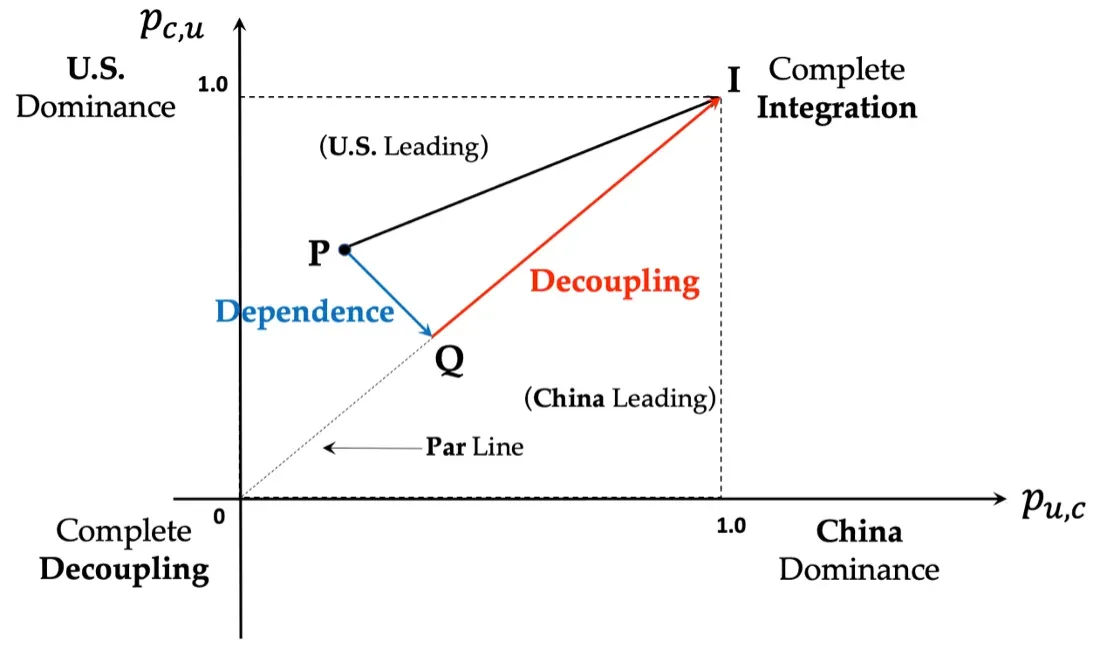
Figure 1 illustrates our approach. The vertical axis captures how often Chinese patents cite U.S. patents relative to Chinese ones; the horizontal axis captures the reverse. The origin represents complete decoupling, namely, mutual non-citation, and the point (1, 1) represents complete integration, where patents cite foreign work as often as domestic work. The 45-degree line marks parity: citations flowing equally in both directions.
Any real-world observation sits somewhere in this space. To interpret it, we project it onto the parity line. The distance along the parity line toward the integration point measures the degree of decoupling, while the distance from the parity line captures asymmetric dependence, that is, how much more one country relies on the other’s technology.
Figure 1. Measures of Technology Decoupling and Dependence
We merge this patent-based framework with financial data for publicly listed firms in both countries—drawn from Compustat for U.S. firms and CSMAR for Chinese firms—and use difference-in-differences regressions to evaluate two landmark policy interventions: China’s Strategic Emerging Industries (SEI) initiative and the expansion of the U.S. Entity List. To trace how sanctions ripple beyond their direct targets, we also construct a technology network based on patent citation flows, distinguishing upstream from downstream linkages.
Findings
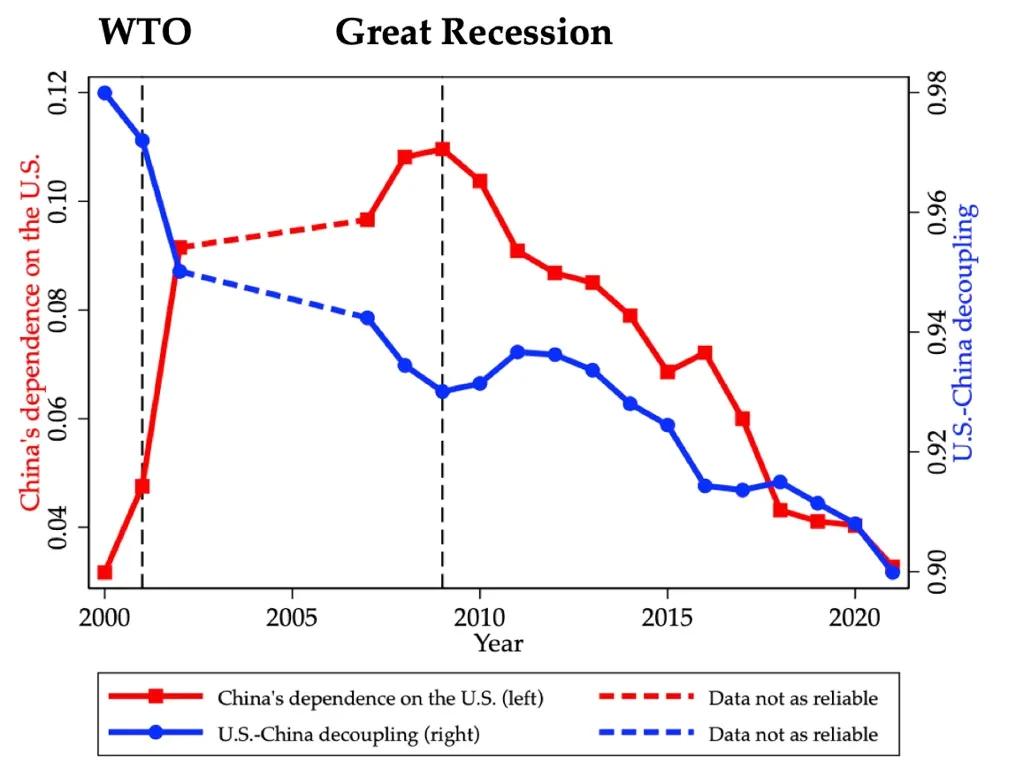
The big picture may surprise those who follow the decoupling narrative. As Figure 2 shows, U.S.–China technology integration has been increasing steadily since 2000, the year before China joined the WTO. The dominant trend of the 21st century is not separation but convergence. China’s dependence on U.S. technology, however, tells a more nuanced story: it rose through most of the 2000s, peaked around 2009, and has since declined. The first decade was a period of dependence-deepening integration; the second brought integration with growing Chinese independence.
Figure 2. U.S.–China Technology Decoupling and Dependence over Time
What does decoupling do to firms? Two opposing forces are at work. Integration facilitates knowledge spillovers that complement domestic innovation. However, decoupling can force firms to innovate rather than imitate and may even shield them from foreign competition in the process. Our data show the substitution effect wins, at least for patent counts: Chinese firms in more decoupled sectors produce more patents, but at a steep cost. Profitability, productivity, and firm valuations all decline. U.S. firms, by contrast, show little sensitivity to decoupling, consistent with their continued leadership in most technology fields.
The policy analysis yields results that should give pause to architects of both countries’ strategies. China’s SEI initiative, which the U.S. characterized as a bid for self-sufficiency through import substitution, is instead associated with more integration, not less. Firms in SEI-targeted sectors became less decoupled from U.S. technology and saw gains in cash flows and valuations, but showed no measurable improvement in innovation quality or productivity.
U.S. sanctions tell an even more counterintuitive story. Sanctioned Chinese firms and their downstream partners experience declines in profitability and innovation output. However, firms upstream of the sanctioned sectors respond by becoming more productive and producing more original, discovery-oriented research. The sanctions create a pressure gradient: pain at the point of impact, but renewed inventive energy one step removed. This finding highlights a fundamental tension in the sanctions’ design. The stated goal is to constrain China’s technological capabilities, but the networked nature of innovation means the effects can undermine that objective.
Implications
For policymakers, our findings suggest technology sanctions are a blunter and more unpredictable instrument than they may appear. The innovation network does not respect the boundaries drawn by export control lists. Restricting one node can energize others, and the net effect on a country’s technological trajectory may differ sharply from what any single sanction was designed to achieve. As both governments contemplate the next round of restrictions—on AI chips, quantum computing, and biotechnology—our framework offers a way to trace where the effects are likely to land.
For firms and investors, the message is that technological self-sufficiency is not free. Decoupling generates more patents but not more profits. The long-term winners will be firms that can innovate independently while remaining connected to global knowledge flows, a balancing act that becomes harder as policy barriers rise.
More broadly, our study demonstrates that decoupling is not a binary state but a continuous, measurable quantity. Measuring it changes the conversation. Instead of debating whether decoupling is “happening,” we can now ask how much, where, and with what consequences. We hope this framework will prove useful for scholars, policymakers, and strategists navigating the most consequential technology competition of our era.