
HKU Jockey Club Enterprise Sustainability Global Research Institute
World-Class Hub for Sustainability
Wei Jiang | Junyoung Park | Rachel Xiao | Shen Zhang
AI and the Extended Workday: Productivity, Contracting Efficiency, and Distribution of Rents
Oct 20, 2025
Key Takeaways
- This paper examines how occupational AI exposure affects workers’ time allocation, focusing on work hours and leisure.
- Using US time-diary data from 2004–2023, the authors find greater AI exposure is associated with longer workdays and reduced leisure, particularly after the release of ChatGPT.
- Leisure reduction comes from socialization and not screen-based activities.
- These changes stem from productivity complementarity and improved monitoring efficiency, rather than from task automation or job displacement.
- Workers in competitive labor markets are less able to retain the productivity gains generated by AI; instead, employers capture them. Similarly, the productivity surplus mostly benefits consumers in sectors with competitive product markets, leaving little for firms to share with workers.
- These findings challenge the view that AI will ease the human labor burden; rather, it may exacerbate overworking and undermine work-life balance.
Source Publication:
Wei Jiang, Junyoung Park, Rachel Xiao, and Shen Zhang. “AI and the Extended Workday: Productivity, Contracting Efficiency, and Distribution of Rents.” SSRN Working Paper

Background and Research Questions
As artificial intelligence (AI) technology evolves, its integration into various sectors of the economy has sparked a debate about the potential consequences for labor markets. Although much attention has focused on the automation of tasks and the displacement of workers, less is known about how AI affects the intensive margin of labor—specifically, the allocation of time between work and leisure.
This paper investigates how AI exposure influences the length of the workday and the distribution of leisure time. By examining individual-level time-diary data, the authors aim to answer whether AI increases the total number of hours worked, and if so, whether this increase is driven by the productivity-enhancing effects of AI or its ability to monitor and incentivize work effort. The research also explores how competitive labor market conditions and firm-level incentives might shape the distribution of these productivity gains, with a particular focus on workers’ bargaining power and the resulting implications for work-life balance.
Data and Methodology
The authors use the American Time Use Survey (ATUS) data from 2004 to 2023, comprising approximately 250,000 individual-level daily time diaries representative of the US population. Each respondent is matched to an occupational AI exposure score constructed using O*NET task data and natural language processing–based AI capability indicators.
The empirical strategy includes fixed-effects regressions controlling for individual characteristics, year, and occupation. A difference-in-differences design exploits the release of ChatGPT in November 2022 as a plausibly exogenous shock to AI salience. Key outcome variables include total hours worked and minutes spent on leisure activities.
Findings and Discussion
The study finds individuals in occupations with higher AI exposure work significantly longer hours and spend less time on leisure than those in low-exposure occupations. These effects increase after the ChatGPT release, suggesting AI adoption has intensified work effort in exposed sectors.
Figure 1 AI Exposure and Workday
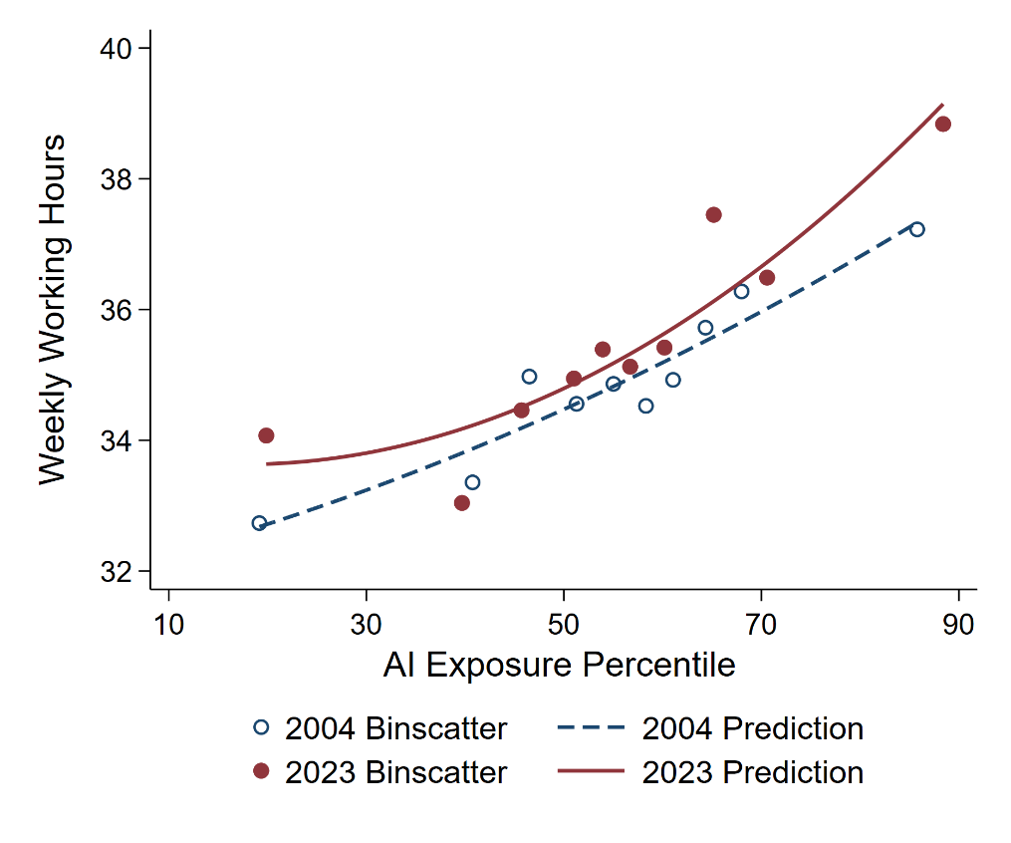
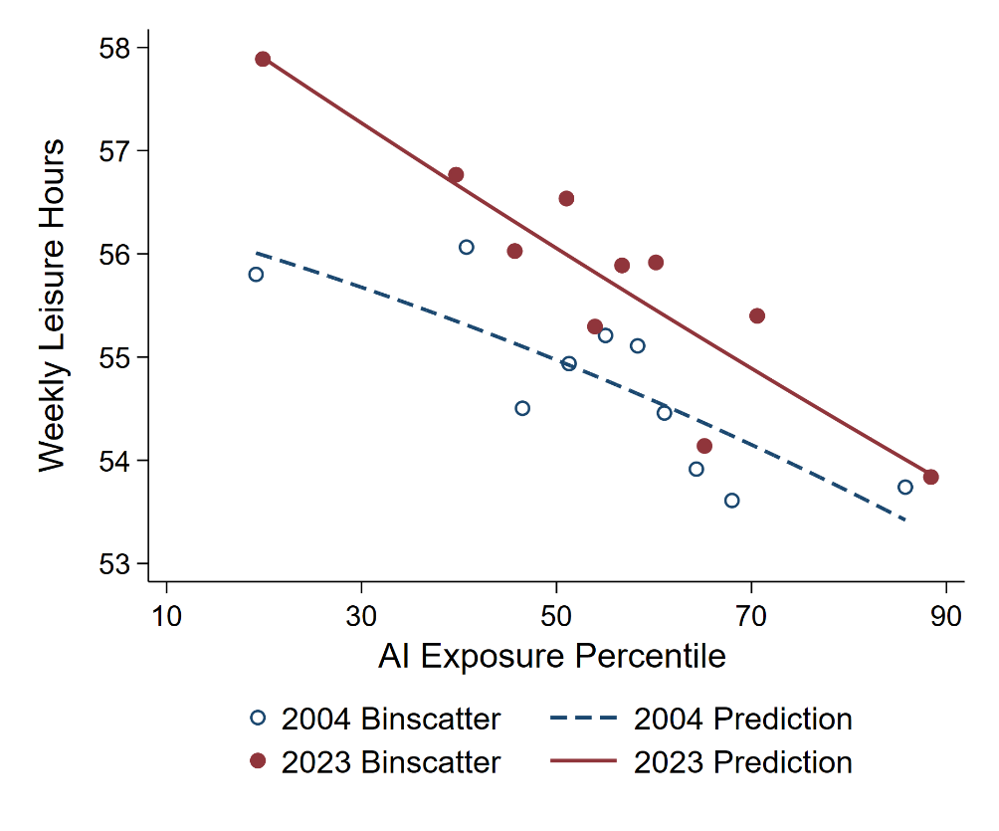
Note: The figure plots the average weekly hours allocated to work (Panel A) and leisure (Panel B) over occupation-level AI exposure in percentile rank. The time allocation variables are derived from the American Time Use Survey (ATUS) for the periods 2004–2013 and 2014–2023, weighted using ATUS sampling weights. Blue scatters and the blue dotted line represent data from 2004–2013, whereas red scatters and the red line correspond to 2014–2023. The scatters depict binned averages across 10th percentile groups, and the lines represent fitted values from quadratic regressions.
The mechanism operates through productivity complementarity: AI tools enhance marginal productivity, increasing the returns to additional work effort. In addition, AI improves monitoring and performance evaluation, leading to more effective contract enforcement. The result is an increase in labor input without corresponding increases in compensation or leisure.
The paper also shows workers in competitive labor markets are unable to retain the surplus generated by AI. Instead, productivity gains are passed on to firms (through profits) or consumers (through price reductions). These distributional outcomes are particularly pronounced in occupations with limited bargaining power and high measurability of output.
Policy or Market Implications
The findings from this study highlight the increasing challenges that AI-driven productivity gains present for workers, particularly in occupations with high AI exposure. The reduction in leisure time and extension of work hours is not offset by increases in compensation, because productivity gains are captured by firms or consumers rather than workers themselves. This trend underscores the need for labor regulations that protect workers’ well-being in an AI-powered environment. Policymakers should consider updating labor laws to address the intensification of work, especially in sectors heavily affected by AI. This policy could involve stronger regulations around work-hour limits, mandated rest periods, or better compensation structures to ensure the benefits of AI are more equally distributed.
For firms, the growing pressure to extract more labor from workers through AI tools comes with significant risks. Prolonged work hours without sufficient compensation or time for rest could lead to higher burnout rates, lower employee morale, and increased turnover. Companies need to balance the adoption of AI with the well-being of their workforce, potentially incorporating better benefits, health programs, or job flexibility. The study also raises broader societal questions about the future of work and the need for a fairer distribution of AI’s economic rewards. Without such interventions, AI could exacerbate existing labor market inequalities, further marginalizing workers in less competitive sectors.

