HKU Jockey Club Enterprise Sustainability Global Research Institute
World-Class Hub for Sustainability
Runtong Lin | Tse-Chun Lin
Smile, Cultural Distance, and Altruistic Behaviors
Aug 20, 2025
Key Takeaways
- Research Question: Do smiles unambiguously promote altruistic behaviors? How does the cultural distance between fundraisers and lenders influence the smile–altruism relationship?
- Data & Method: We use computer vision algorithms to quantify smile intensity in over 1.3 million fundraiser photos from Kiva, a US crowdfunding platform. We measure cultural distance using Obradovich et al.’s (2022) data on topic interests from Facebook. Fundraising outcomes and other characteristics of fundraising campaigns are collected from Kiva’s API.
- Findings:
- Smiling fundraisers are, on average, more successful: A one-point increase in smile intensity (on a scale from 0 to 5) reduces fundraising failure by 7.5% and accelerates funding by 3.2%.
- The smile’s effect follows a non-linear “cultural valley”: it is strongest at moderate cultural distances and weakens as the cultures of the recipients and the senders become too similar or too distinct.
- This cultural-valley effect is mainly driven by contemporary, secular cultural interests, such as news, entertainment, and multinational brand engagements. The role of cultural distances related to languages and religions is limited.
- Implication: Fundraising platforms can improve outcomes by matching fundraisers and lenders with moderate levels of cultural similarity. The improvement in fundraising outcomes is greater in campaigns where the fundraisers smile.
Source Publication: Lin, R., & Lin, T.-C. (2025). Smile, Cultural Distance, and Altruistic Behaviors. SSRN Working Paper.

Background and Research Questions
The human smile serves as an important signal that facilitates cooperation and altruism in social interactions. Cultural distance, which broadly covers the divergence in values, norms, beliefs, and practices between groups, affects how smiles are perceived.
Fundraising has become increasingly digital and global with the help of fintech. Crowdfunding platforms connect fundraisers and lenders from diverse cultural backgrounds. We ask the following research question: Does a smile on a fundraiser’s photo universally encourage altruism, or does its influence depend on how culturally similar or different the lenders and the fundraiser are on crowdfunding platforms?
Figure 1: Kiva Fund Flow Map.
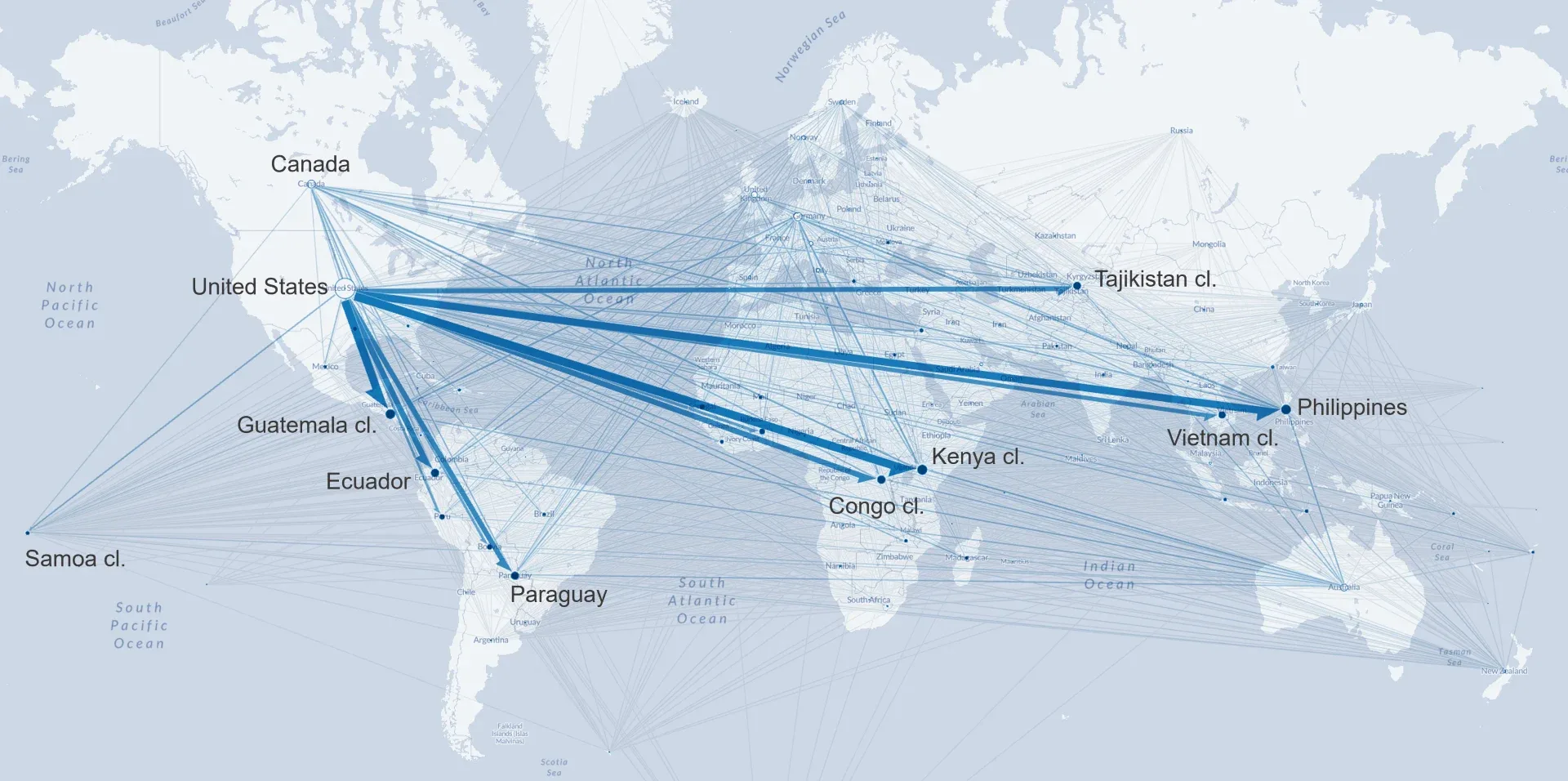
Note: The thickness of the arrows represents the amount of charitable fund flow between two countries. “cl.” indicates the dot on the graph is a cluster of several countries.
Data and Methodology
The fundraising campaigns that we analyze are from Kiva, a US charitable crowdfunding platform. Figure 1 visualizes the between-country fund flows on Kiva in the year 2020, with the US as a major source of fund outflow and various developing countries in Africa, South America, and Asia as major fund-flow destinations.
As of 2023, lenders on Kiva had crowdfunded 2.4 million loans worth over $2 billion US dollars, connecting 2 million charitable lenders to 5 million borrowers across 77 countries. The crowdfunders on Kiva lend at zero interest, so their participation is altruistic.
We use the OpenFace 2.0 toolkit (Baltrusaitis et al. 2018) to detect smiles from facial action units (AUs) in fundraiser photos that we collect from Kiva’s API. These photos are prominently displayed alongside the fundraising campaigns and likely affect the crowdfunders’ decisions. Smile intensity is quantified with the contraction of the zygomatic major muscle (AU12), which allows for consistent, algorithmic measurement across more than 1 million images.
Our measure of cultural distance is from Obradovich et al. (2022), who use Facebook data to measure cultural distances between Facebook users in different countries on nearly 60,000 topic dimensions. We re-aggregate this country dyad–level measure to the fundraising campaign level using actual Kiva fund flows across countries. For each campaign and its fundraiser, the measure reflects the weighted cultural distance between the fundraiser and the pool of potential lenders active on Kiva.
Findings and Interpretation
The baseline findings confirm that, on average, smiles significantly increase fundraising success. Independent of other facial traits, stronger smile intensity reduces the probability of campaign failure and accelerates the time required to meet funding goals.
Furthermore, the smile–altruism relationship is not uniform across all cultural pairings. The smile effect is strongest at moderate levels of cultural distance and diminishes toward both ends of the distribution. A Bayesian interpretation is that the lenders’ uncertainty about the fundraisers is greatest at intermediate cultural distances. Such fundraisers are neither clearly “friends” (highly culturally similar) nor clearly “foes” (highly culturally distant), so prosocial signals such as smiles are more informative and generate larger responses from lenders.
Figure 2: The Cultural Valley in the Smile–Altruism Link.
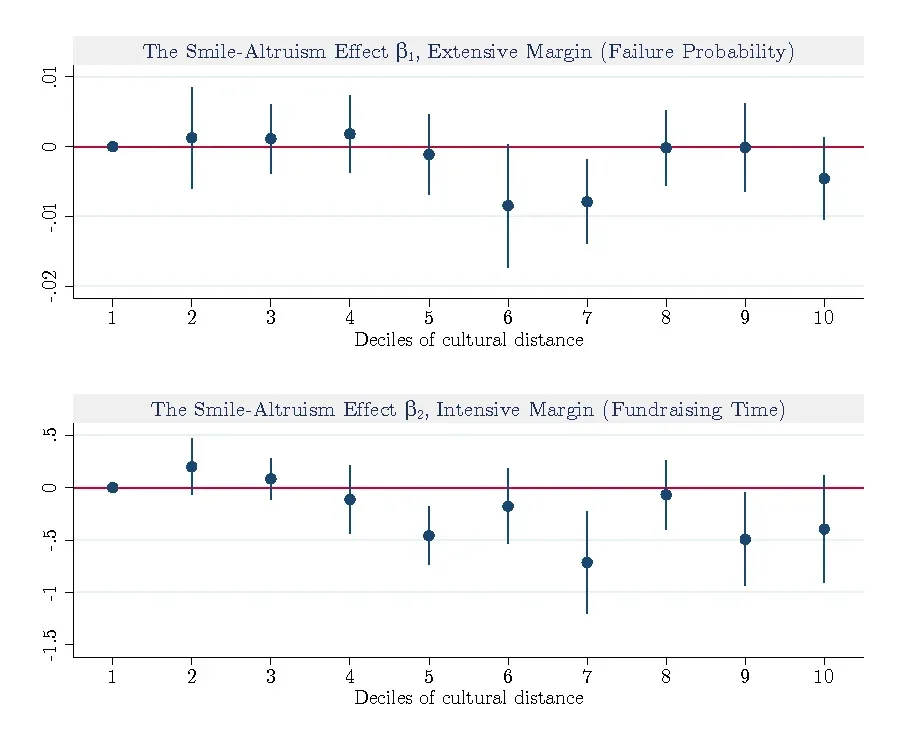
Note: The x-axis plots 10 deciles of cultural distance. The y-axis plots the effects of smiles on altruistic behaviors within each decile. For the extensive-margin regression visualized in the top panel, Failure l is an indicator variable that equals 1 if the fundraising campaign for loan l fails. For the intensive-margin regression visualized in the bottom panel, Days to fundl is the number of days it takes for loan l to be funded. Smilel is the activation intensity of AU12 (the oblique widening of the lip corners) algorithmically measured from the photos of the fundraisers. Cultural distancel is the average cultural distance (Obradovich et al., 2022) between loan l’s receiver and all potential senders who are active on the Kiva platform in the year that loan l is posted.
The cultural valley suggests the existence of an optimal degree of cultural distinctiveness that enhances the communicative power of smiles. A further decomposition of the cultural-distance measure shows contemporary, secular cultural differences (e.g., interests in news, entertainment, and multinational brand engagement) are more prominent moderators of the smile effect than religious or linguistic cultural differences.
Policy and Market Implications
Platforms can improve fundraising outcomes by matching fundraisers with donors at optimal cultural distances, where smiles are most likely to be interpreted positively and build trust. More broadly, in the increasingly digital and global fundraising landscape, platform designs can benefit from awareness of cultural differences.
Reference
Baltrusaitis, T., Zadeh, A., Lim, Y. C., & Morency, L.-P. (2018). OpenFace 2.0: Facial Behavior Analysis Toolkit. 2018 13th IEEE International Conference on Automatic Face & Gesture Recognition (FG 2018), 59–66.
Obradovich, N., Özak, Ö., Martín, I., Ortuño-Ortín, I., Awad, E., Cebrián, M., Cuevas, R., Desmet, K., Rahwan, I., & Cuevas, Á. (2022). Expanding the measurement of culture with a sample of two billion humans. Journal of The Royal Society Interface, 19 (190), 20220085.