
HKU Jockey Club Enterprise Sustainability Global Research Institute
World-Class Hub for Sustainability
Kuanning Cai | Jia Guo | Jeffrey Ng | Nan Yang
Healthcare Workers’ Pay Transparency and Patient Satisfaction
Oct 30, 2025
Key Takeaways
- Research question: How does healthcare workers’ pay transparency affect patients’ satisfaction with their hospital experience?
- Data: We used hospital-year patient-satisfaction data from HCAHPS, merged with pay-transparency information and hospital characteristics from AHA Annual Survey and HCRIS, covering 240,653 hospital-year observations from 3,866 hospitals (2008–2019).
- Method: The study exploits the staggered, state-level implementation of pay-transparency laws as an exogenous shock, using a stacked difference-in-differences (DID) design, complemented by cross-sectional analyses and falsification tests to establish causality.
- Findings:
- Pay-transparency laws significantly increase patient satisfaction, with an effect size of 7.69% of the standard deviation of overall ratings.
- The effect is stronger in Democratic states, hospitals with larger pre-existing gender pay gaps, non-profit or government-owned hospitals, and hospitals with higher labor intensity.
- The laws reduce gender-based and overall wage inequality, raises wages for lower-paid employees, and lowers 30-day unplanned readmissions for heart attack and heart failure patients, indicating improved healthcare quality.
- Implications: Mandating pay transparency enhances patient satisfaction and healthcare quality by improving wage equity and employee motivation, linking social fairness to better organizational performance.
Source Publication:
Kuanning Cai, Jia Guo, Jeffrey Ng and Nan Yang. Healthcare Workers’ Pay Transparency and Patient Satisfaction, SSRN Working Paper.

Background and Research Questions
Pay-transparency laws aim to reduce wage information asymmetry and foster fairer workplaces. Although prior research has examined their effects on employees’ wages, job satisfaction, and firm performance, little is known about the downstream impact on customers.
This study addresses this gap by asking, “Does increased pay transparency among healthcare workers improve patient satisfaction, and if so, through which mechanisms?”
Data and Methodology
The study integrates patient-satisfaction measures from HCAHPS with pay-transparency legislation data and hospital-level characteristics from AHA Annual Survey and HCRIS. The resulting dataset spans 3,866 hospitals over 12 years, comprising 240,653 hospital-year observations.
To identify causal effects, the study exploits the staggered implementation of state-level pay-transparency laws as a quasi-exogenous shock. A stacked DID framework compares changes in patient satisfaction in hospitals subject to the laws with those in unaffected states. Cross-sectional analyses explore heterogeneity and underlying mechanisms. Falsification tests and survival models (Cox hazard and Weibull) confirm law enactment is not driven by pre-existing patient-satisfaction trends.
Findings and Discussion
The analysis reveals a robust positive effect of pay transparency on patient satisfaction. Hospitals in states with pay-transparency laws report higher satisfaction scores, with an effect equivalent to 7.69% of the standard deviation of overall ratings. This finding aligns with the fair wage–effort theory, which suggests employees who perceive compensation as fair are more motivated to exert effort, translating into higher-quality care.
Figure 1 Parallel-trend figures
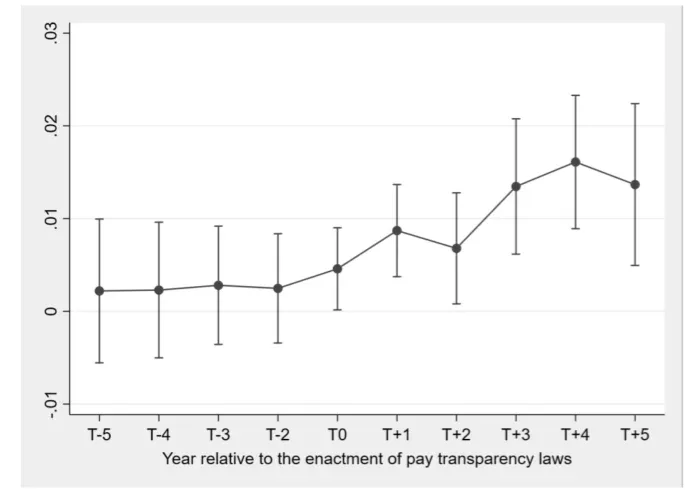
Figure 1a [t-5, t+5] time window
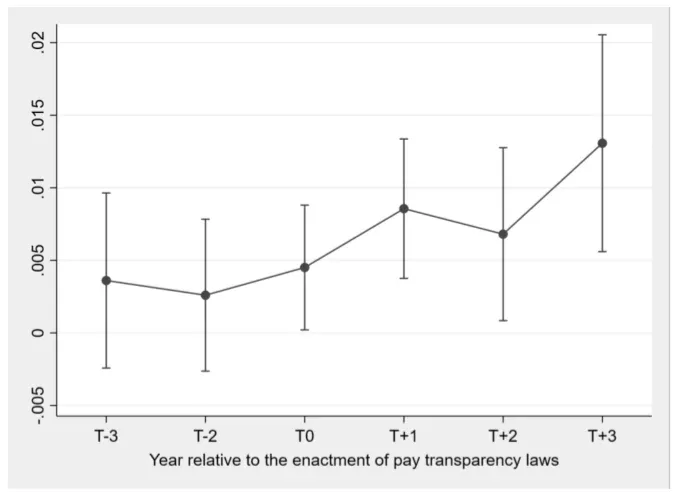
Figure 1b [t-3, t+3] time window
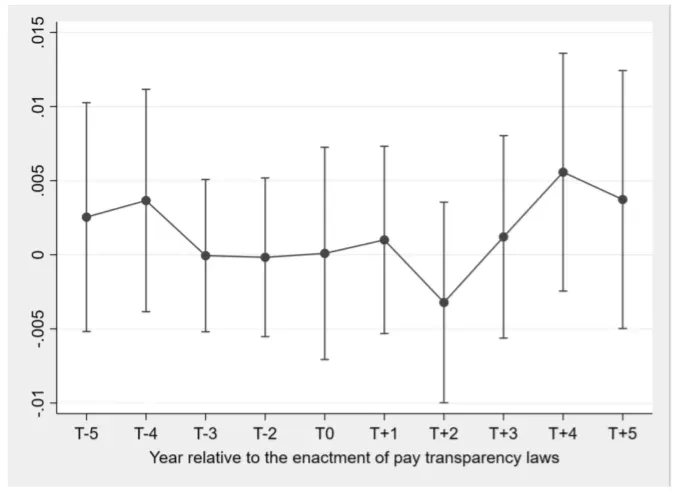
Figure 1c Pseudo enactment year
Note: The figures show the dynamic effects of pay-transparency laws on patient satisfaction. The x-axes show the year relative to the year of the pay-transparency law’s enactment. The y-axes plot the coefficients on the interaction terms between Treat and various time dummies. Figure 1a displays the results from estimating equation (2), with separate indicators for the five years before and after adopting a pay-transparency law. Figure 1b displays the results with separate indicators for the three years before and after adoption, as well as the coefficient estimates for each year and their 95% confidence intervals. Figure 1c displays the results from using the third year that precedes the actual enactment year as the pseudo treatment year.
Mechanism analyses highlight several sources of heterogeneity. The positive impact is stronger in Democratic-leaning states, consistent with greater political salience of pay equity. Hospitals with larger pre-existing gender pay gaps or those that experienced a substantial reduction post-law show more pronounced effects, indicating improved female employee satisfaction drives better patient experiences. Non-profit and government hospitals exhibit larger gains than for-profit, physician-owned hospitals, reflecting differences in employee motivation. Hospitals with higher labor intensity see stronger improvements, suggesting the effect operates primarily through hospital staff delivering care.
Supplementary findings show pay transparency reduces both gender-based and overall wage inequality, increasing wages for lower-paid employees while leaving higher-paid employees largely unaffected. The laws also reduce 30-day risk-standardized unplanned readmissions for heart attack and heart failure patients, confirming improved employee motivation translates into measurable improvements in healthcare quality.
Policy or Market Implications
These results provide compelling evidence that pay transparency is not merely an ethical or regulatory concern, but also a practical strategy for enhancing patient satisfaction and care quality. By fostering wage equity and improving employee morale, hospitals can improve outcomes for patients and strengthen workforce stability.
For policymakers, the findings highlight a tangible, empirically supported benefit of pay-transparency regulations, demonstrating that promoting social fairness can directly enhance economic performance in service-intensive sectors. For hospital administrators, adopting transparent pay practices can yield both improved patient satisfaction and reduced re-admissions, aligning operational performance with social responsibility goals.
Overall, the study reinforces the link between social sustainability (fair labor practices) and economic sustainability (service quality and patient outcomes), providing actionable insights for the healthcare sector and beyond.