
HKU Jockey Club Enterprise Sustainability Global Research Institute
World-Class Hub for Sustainability
Vikas Agarwal | Wei Jiang | Yuchen Luo | Hong Zou
The Real Effect of Sociopolitical Racial/Ethnic Animus: Mutual Fund Manager Performance during AAPI Hate
Aug 20 2026
Key Takeaways
- Research Question: Can racial and ethnic animus in the broader social environment impair the decision-making and performance of targeted professionals, even without direct workplace or marketplace discrimination?
- Data: The study examines 2,316 actively managed U.S. mutual funds from 2019 Q1 to 2021 Q1. The main analysis compares 436 funds managed by women perceived as East Asian with other female-managed funds.
- Method: Using a difference-in-differences design, the authors compare changes in fund performance during the 2020 surge in anti-Asian hate. Fund and state-by-time fixed effects account for persistent fund differences and local pandemic conditions.
- Findings:
- For a fund in which perceived East Asian women constituted half of the management team, monthly risk-adjusted returns fell by approximately 22.5 basis points relative to other female managed funds.
- The decline was greater in states with higher anti-Asian animus and when affected managers played a larger role in investment decisions.
- Portfolio evidence points to weaker stock selection and private-information generation, with no corresponding decline in portfolio activeness or responsiveness to public information.
- Implications: Sociopolitical hostility can impair professional decision-making and impose economic costs even without observable discrimination by employers, coworkers, or investors.
Source Publication:
Agarwal, Vikas, Wei Jiang, Yuchen Luo, and Hong Zou. 2026. “The Real Effect of Sociopolitical Racial/Ethnic Animus: Mutual Fund Manager Performance during AAPI Hate.” The Review of Financial Studies
Background
Research on racial and ethnic bias has largely examined discrimination within workplaces and markets, including unequal access to employment, promotion, credit, investment capital, and financial services. Yet hostility in the broader social environment may create another form of economic harm. Fear, anxiety, and stress can consume cognitive resources and interfere with complex decision-making, even when the targeted individuals do not encounter discriminatory treatment from employers, coworkers, clients, or investors.
The surge in hate directed at Asian Americans and Pacific Islanders during the COVID-19 pandemic provides an opportunity to examine this possibility. Beginning in early 2020, people perceived as Chinese or East Asian faced rising levels of scapegoating, harassment, and violence. Women were particularly exposed: reported hate incidents involving women were more than twice as frequent as those involving men.
The authors examine whether this hostile social environment affected the professional performance of those most likely to be targeted. The mutual fund industry makes it possible to observe both investment returns and the portfolio decisions underlying them. The study can therefore go beyond documenting performance changes and investigate how sociopolitical animus may affect professional decision-making.
Data and Methodology
The authors combine the CRSP Survivor-Bias-Free U.S. Mutual Fund Database with Morningstar Direct. The sample covers actively managed U.S. equity, bond, allocation, sector, and alternative-strategy funds from the first quarter of 2019 through the first quarter of 2021. Index funds, funds with less than $15 million in assets, and funds younger than three years are excluded. The analysis is limited to funds managed by the same team before and after the onset of the pandemic, reducing concerns that changes in management account for the results.
The resulting dataset contains 16,540 fund-quarter observations for 2,316 funds. The main difference-in-differences analysis uses 2,915 observations for 436 funds with at least one female portfolio manager.
Because anti-Asian hostility during this period frequently targeted people based on perceived appearance rather than verified ethnicity or nationality, the authors identify managers who could be perceived as East Asian. They combine name-based classification, biographical information, and manual examination of publicly available photographs.
The primary analysis compares funds managed by women perceived as East Asian with funds managed by other women. Restricting the comparison to female-managed funds helps separate exposure to anti-Asian animus from the pandemic’s broader effects on women, including gender differences in childcare and household responsibilities. The treatment intensity is measured by the share of a fund’s management team consisting of women perceived as East Asian.
The authors designate the second quarter of 2020 through the fourth quarter of 2020 as the period of heightened anti-Asian animus. The first quarter of 2020 is excluded from the analysis to avoid ambiguity. Fund fixed effects account for persistent differences in managerial ability and investment strategy. State-by-time fixed effects allow the analysis to compare funds operating under the same local pandemic restrictions, economic conditions, and other contemporaneous shocks.
Figure 1 Scaled versus unscaled time series of AAPI hate crimes
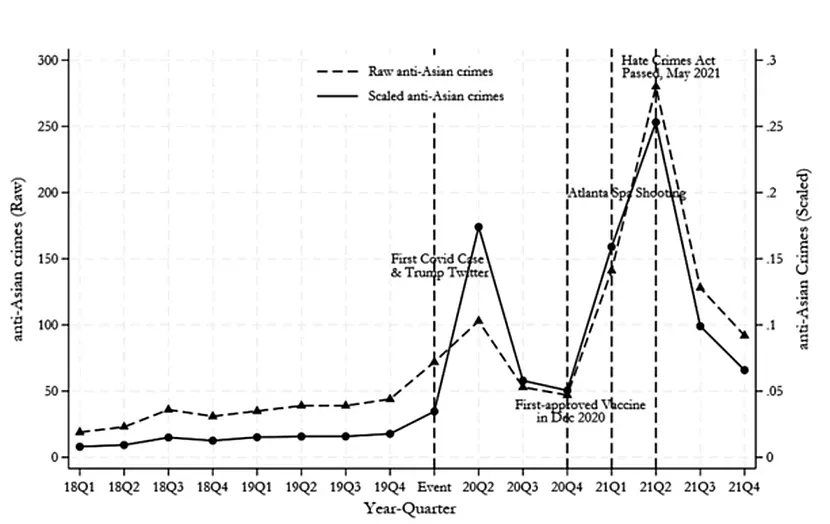
Notes: Graph plotting the unscaled and scaled quarterly series of hate crimes against Asians from 2018 Q1 to 2021 Q4. The unscaled data come from the FBI Uniform Crime Reports (UCR). The scaled series are constructed by dividing the raw counts by the number of passengers boarding public transit vehicles (in millions), which are collected from the Federal Transit Administration. We exclude hate crimes that occurred in private residences from our hate crime statistics.
Fund performance is measured using abnormal returns relative to standard risk-factor models and investment-category benchmarks. Using the relevant equity-fund and portfolio-holdings subsamples, the authors then examine stock selection, interim trading, position initiations and terminations, portfolio activeness, and the processing of public and private information.
Findings and Discussion
Fund performance declined during the surge in anti-Asian animus
Before 2020, funds managed by perceived East Asian women and other female-managed funds followed similar performance trends. Their returns diverged in 2020 Q2, remained lower through the end of the year, and converged again by 2021 Q1.
Figure 2 The validity of parallel trend analysis for the female-managed fund sample
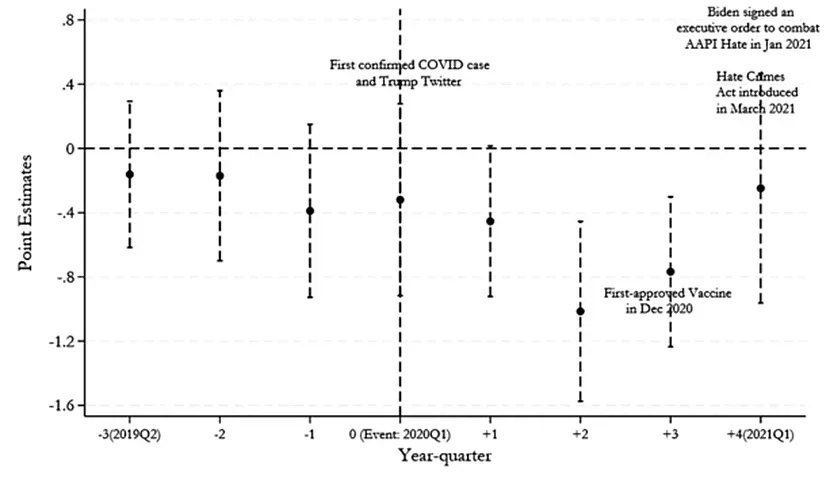
Notes: This figure plots the point estimates from the dynamic DiD test on the effects of anti-Asian animus on the performance of funds with at least one Asian female manager. Marked confidence intervals are at the 95% confidence level, using robust standard errors that are clustered at the fund level.
The decline increased with affected managers’ share of the team. When perceived East Asian women constituted 50% of the management team—close to the average among affected funds—monthly risk-adjusted abnormal returns fell by approximately 22.5 basis points.
Comparable declines did not appear among funds managed by female managers who were not perceived as East Asian, including South Asian, non-white Hispanic, and Black female managers, suggesting that the observed declines are not driven by heightened prejudice against minority groups during the COVID-19 pandemic. The results also cannot be explained by investor redemptions, exposure to Chinese financial markets, childcare responsibilities, or concerns about relatives abroad.
The decline was greater where exposure and managerial influence were stronger
Underperformance was more pronounced in states with higher anti-Asian animus, measured using reported hate-crime victims and geolocated social-media posts containing anti-Asian slurs.
The effect was also stronger when affected managers’ judgment mattered more to fund performance. It was larger in funds with high portfolio turnover or aggressive investment objectives and approximately 1.5 times greater in funds with three or fewer managers. The decline was statistically significant when perceived East Asian women served as sole, lead, or senior managers, but not when they occupied junior roles.
Investment decisions became less effective
Stocks selected by affected funds subsequently earned lower characteristic-adjusted returns, particularly when managers initiated or terminated positions.
The funds’ “return gap”—the difference between actual returns and the returns from passively holding previously disclosed portfolios—also deteriorated. Their interim trades therefore added less value during the period of heightened animus.
Moreover, purchases became less predictive of positive returns around subsequent earnings announcements, while stocks sold performed better than expected. This pattern points to weaker private-information generation.
By contrast, portfolio turnover and active share did not decline, and managers’ responses to public corporate disclosures remained unchanged, suggesting no reduction in the efforts of female managers perceived to be East Asians, but their investment decisions became less effective.
Implications
The findings show that racial and ethnic animus can generate economic costs beyond conventional workplace and marketplace discrimination. A hostile sociopolitical environment may impair professional performance even when employers, coworkers, and investors do not treat targeted individuals differently.
Workplace protections against discrimination therefore may not fully insulate employees from broader sociopolitical hostility. When that hostility weakens decision-making in information-intensive occupations, its consequences can extend to organizations, investors, and the allocation of capital.