
HKU Jockey Club Enterprise Sustainability Global Research Institute
World-Class Hub for Sustainability
Jarrad Harford | Qiyang He | Buhui Qiu
Firm-Level Labor Shortage Exposure
June 16, 2026
Key Takeaways
- Research Question: How does exposure to firm-level labor shortage affect corporate performance, and when does labor scarcity redirect investment and innovation toward labor-saving production technologies?
- Data and Method: The authors apply a fine-tuned FinBERT model to 119,004 earnings call transcripts from 4,261 U.S. public firms between 2005 and 2021, constructing a firm-level measure of labor-shortage exposure from managers’ and analysts’ discussions.
- Findings
- The measure captures meaningful variation in labor constraints: it rises in tight labor markets, predicts future growth in per-employee staff expenses, and increases in response to labor supply shocks such as the 2017 U.S. immigration policy reforms and the 2020 Federal Pandemic Unemployment Compensation program.
- Labor-shortage exposure predicts weaker performance. An interquartile increase in exposure is associated with a 0.552-percentage-point decline in one-year-ahead stock returns and a 0.104-percentage-point decline in one-year-ahead industry-adjusted ROA.
- Firms respond by increasing capital expenditures, R&D, production-process patenting, and AI-related investment, while reducing employees per unit of assets.
- Corporate adjustment depends on firm constraints. Firms with greater wage-setting power rely more on process innovation; firms with repeated exposure make more structural investments; and financially constrained firms are more likely to raise wages because they have less capacity to finance labor-saving technology.
- Implication: The measure is an accurate and useful way to identify labor scarcity. Firms respond to labor shortage by accelerating the shift toward labor-saving technologies, and access to financing is an important factor in whether firms adapt through innovation or remain exposed to rising labor costs.
Source Publication:
Harford, J., He, Q., & Qiu, B. (2026). “Firm-Level Labor Shortage Exposure: Measurement, Economic Implications, and Corporate Responses.” The Review of Financial Studies.
Background
Production is organized around a shifting mix of workers, capital, software, and internal processes. When hiring or retaining labor becomes harder, firms face a real allocation problem: absorb higher labor costs, slow activity, raise compensation, redesign tasks, or invest in technologies that reduce dependence on scarce workers. Labor shortages can therefore affect more than payroll. They can alter margins, capital allocation, and the direction of innovation.
Labor scarcity becomes especially important when it changes the relative value of alternative production technologies. Firms that expect hiring frictions to persist have stronger incentives to substitute toward automation, process redesign, and AI-related capabilities. Firms with limited financial flexibility may have fewer options, leaving them more dependent on wage increases and more exposed to labor cost pressure.
In this paper, the authors examine this link by extracting firm-level labor-shortage exposure from earnings conference calls. They test whether exposed firms experience weaker stock market and operating performance, and whether those firms respond by changing capital spending, employment intensity, R&D, process innovation, and AI-related investment.
Data and Methodology
The authors construct a firm-level measure of labor-shortage exposure from earnings conference call transcripts of U.S. public firms between 2005 and 2021. They begin with 136,169 transcripts from Standard & Poor’s Capital IQ and merge the text data with stock returns from CRSP, financial data from Compustat, labor market data from the Bureau of Labor Statistics and Bureau of Economic Analysis, and patent data. The final sample contains 36,179 firm-year observations linked to 119,004 earnings call transcripts and 4,261 firms.
They use FinBERT, a finance-specialized language model, to detect labor-shortage-related sentences. The use of FinBERT is important because labor scarcity is not always described through obvious keywords. Managers may refer to “an intense hiring environment,” “staffing constraints,” “wage pressure,” “difficulty filling roles,” or other language that standard dictionary methods can miss. After manual labeling and model training, the fine-tuned FinBERT model reaches 95% accuracy in classifying labor-shortage-related sentences.
The exposure measure is calculated as the share of labor-shortage-related sentences in a firm’s earnings calls in a given year. The authors validate the measure in several ways. Aggregate exposure rises during periods of broad labor market stress, especially around the COVID-19 period. Labor-intensive industries, including construction, transportation, and services, rank among the most exposed. At the state and industry levels, higher exposure is associated with lower unemployment, greater labor market tightness, and stronger future wage growth. The measure also increases after two labor supply shocks: the 2017 U.S. immigration policy reforms and the 2020 Federal Pandemic Unemployment Compensation program.
Figure 1 Top-10 industries by average labor-shortage exposure
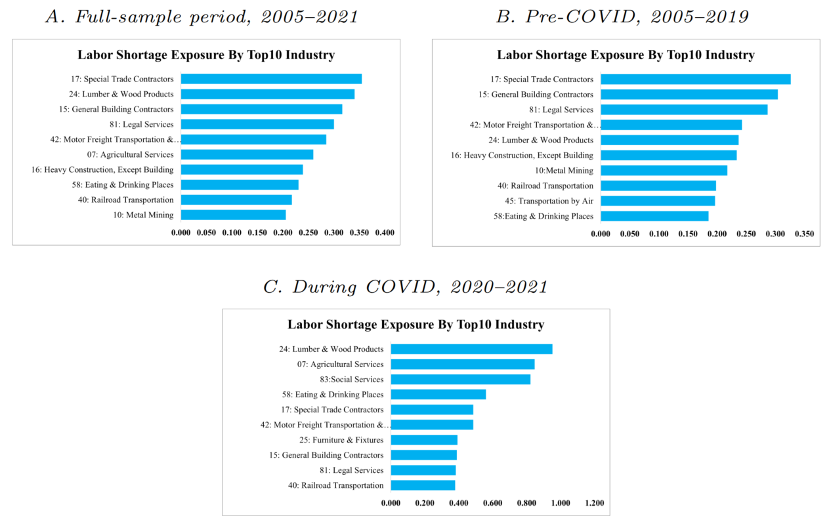
Note: This figure ranks the 10 industries with the highest average labor-shortage exposure. Panel A shows rankings for the full sample period (2005–2021), panel B for the pre-COVID period (2005–2019), and panel C for the COVID period (2020–2021). Construction-related industries, lumber and wood products, transportation, and legal services rank among the most exposed industries across periods, while agricultural services, social services, and eating and drinking places become more prominent during the COVID period.
Findings and Discussion
Labor-shortage exposure contains information about firm value. Firms with greater exposure experience lower cumulative abnormal returns around earnings calls, indicating investors view labor-shortage discussions as unfavorable news. The effect also extends beyond the announcement window. An interquartile increase in exposure predicts a 0.552-percentage-point decline in stock returns over the following year and a 0.104-percentage-point decline in one-year-ahead industry-adjusted ROA.
These performance effects are consistent with the economics of labor scarcity in imperfectly competitive labor markets. Firms may be able to hire more workers by raising pay, but wage adjustments can increase compensation costs for both new and incumbent employees. Labor-shortage exposure also predicts higher future growth in per-employee staff expenses, suggesting managers’ discussions capture real hiring frictions and wage pressure rather than general negative sentiment.
The corporate response appears in the firm’s input mix. Labor-shortage exposure predicts higher capital expenditures and R&D in the following year, along with fewer employees per million dollars of assets. This pattern indicates firms facing scarce or more costly labor shift resources toward nonlabor inputs. The adjustment is not large enough to erase the performance costs immediately, but it indicates labor shortages affect capital allocation rather than only current wage bills.
The innovation evidence shows where this adjustment is concentrated. Exposed firms produce more production-process patents over the next three years, while the relation with nonprocess patents is statistically weak. Process patents are tied to how firms produce goods and services. They are more closely connected to efficiency, automation, and workflow redesign than to new products for sale. Labor scarcity therefore appears to redirect innovation toward production methods that can economize on human labor.
The AI results point in the same direction. Firms exposed to labor shortages increase investment in AI-related personnel and produce more AI-related patents. These findings add an important channel to the discussion of automation. Firms adopt AI not only because the technology frontier advances, but also because they have stronger incentives to adopt labor-saving technologies when hiring constraints raise the cost of relying on workers.
The response differs across firms. Companies with greater wage-setting power show weaker wage responses and stronger reliance on process innovation. Firms with repeated exposure to labor shortages increase R&D and process innovation more strongly, consistent with the idea that persistent constraints justify more durable production changes. Financially constrained firms respond differently: they raise wages more and invest less in labor-saving technologies. Access to finance therefore shapes whether firms can respond to labor scarcity through structural adjustment or remain exposed to rising labor costs.
The pandemic period provides a stress test for the measure. Firms that had already discussed labor shortages in 2018 and 2019 performed worse during 2020 and 2021 than firms with no prior exposure. Their stock returns and ROA were 8.7 and 3.8 percentage points lower per year, respectively, relative to nonexposed firms. Preexisting labor-shortage exposure therefore identifies firms that are especially vulnerable when labor markets tighten sharply.
The results remain robust when the authors use alternative constructions of the exposure measure, separate management presentations from Q&A sections, control for time-invariant CEO characteristics, use industry-level exposure, and apply a Bartik-style instrumental variable approach. Additional tests show capital expenditures and process innovation help reduce subsequent exposure and mitigate future performance losses.
Implications
The paper shows labor-shortage exposure is a measurable firm-level risk. For investors and analysts, earnings call language provides information about future returns, profitability, and investment needs. Labor-shortage discussions can reveal margin pressure and operating constraints before these pressures are fully visible in accounting outcomes.
For managers and boards, the findings connect workforce constraints to capital allocation. Persistent labor scarcity raises the value of process redesign, automation, and AI-related investment, but these responses depend on financial flexibility. Firms with stronger access to capital can make labor-saving investments, whereas constrained firms may rely more heavily on wage increases and remain more exposed to cost pressure.
For policymakers, the evidence suggests labor market policies can influence the direction of corporate technology adoption. Labor supply shocks, including immigration restrictions and unemployment benefit changes, may affect not only wages and employment but also firms’ incentives to invest in automation and process innovation. Labor scarcity can therefore shape how firms organize production and which technologies they choose to develop.

