
HKU Jockey Club Enterprise Sustainability Global Research Institute
World-Class Hub for Sustainability
Wenzhi (Dave) Ding | Chen Lin | Thomas Schmid | Michael S. Weisbach
Directors’ Incentives from Potential Penalties: Evidence from Their Voting
Aug 6 2026
Key Takeaways
- Research Question: Does observing a professional peer being penalized for negligence make enforcement risk more salient and motivate independent directors to monitor management more actively?
- Data: The study covers 3,728 Chinese listed firms and 19,209 independent directors from 2004 to 2019. It includes 263,276 board meetings and 878,193 proposals, together with 3.7 million bilateral connections formed through overlapping board service.
- Method: The authors use a staggered difference-in-differences design to examine how directors’ voting changes after a former board colleague is penalized. The preferred specification compares connected and unconnected directors serving at the same firm in the same quarter, while excluding directors with direct exposure to the violation or penalty.
- Findings: After a former board colleague is penalized, a director’s probability of dissent increases by approximately 0.46–0.52 percentage points, compared with a sample average of 0.27%. The effect persists for five years and is stronger following more severe penalties, when the directors share a professional background or gender, and when the observing director serves at a firm facing greater regulatory risk. Firms with at least one such director subsequently experience an estimated 0.8-percentage-point reduction in the probability of receiving a regulatory penalty, relative to a baseline of 1.82%.
- Implications: Enforcement affects governance beyond the directors and firms directly involved in a regulatory case. Penalties transmitted through professional networks make the personal consequences of weak oversight more salient, strengthening monitoring incentives at other firms.
Source Publication:
Ding, Wenzhi (Dave), Chen Lin, Thomas Schmid, and Michael S. Weisbach. (2026) “Directors’ Incentives from Potential Penalties: Evidence from Their Voting.” Management Science
Background
Independent directors are expected to scrutinize management, yet effective monitoring requires effort and may bring them into conflict with executives who influence their appointments, compensation, and access to information. What motivates directors to challenge management therefore remains an important question in corporate governance.
Formal rules and penalties create objective incentives, but directors’ behavior may also depend on how they perceive enforcement risk. A penalty imposed on a former board colleague can make the financial, reputational, and career consequences of weak oversight more immediate and personally relevant. Directors may then revise their assessment of their own exposure and become more willing to oppose management.
The study examines whether this heightened salience changes directors’ voting behavior and whether the response is consistent with more effective monitoring.
Data and Methodology
China’s disclosure requirements make it possible to observe an aspect of boardroom behavior that is rarely available to researchers. Since 2004, listed firms have been required to disclose individual board votes. When an independent director votes against a proposal or abstains, the firm must report the director’s identity and stated reason.
The authors reconstruct directors’ professional networks using overlapping board service. A director becomes exposed when a former board colleague is penalized for negligence connected to another firm. The analysis excludes directors who were themselves penalized, directors serving at the penalized firm, and directors associated with related firms. These restrictions separate network-based exposure from direct involvement in the underlying violation.
Figure 1 Board Network Illustration
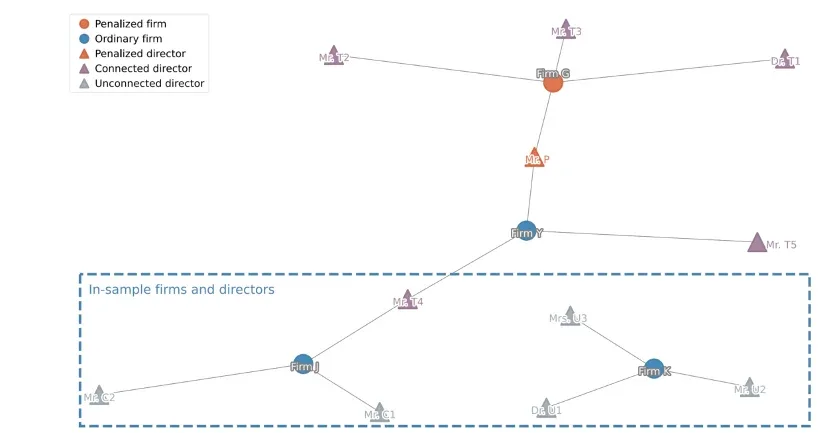
Notes: This figure illustrates our setting based on real data (we mask names to protect privacy). The red circle represents a penalized firm, and blue circles represent nonpenalized firms. The red triangle represents a penalized director, purple triangles represent connected directors, and gray triangles represent control directors. Lines represent the employment relationship between directors (triangles) and firms (circles). Penalized firms and non-penalized firms with penalized directors are excluded from the sample; the blue box shows the firms and directors in our sample. In this example, Mr. P was fined 300,000 Chinese Yuan (CNY) in March 2013 because of his negligence in Firm G (the red circle). At the time that he was penalized, he served as an independent director for Firms G and Y. One of his board colleagues at Firm Y, Mr. T4, also served as an independent director for another firm, Firm J. In our estimations, we compare the change in voting behavior after the penalty event of Mr. T4 with that of the control directors Mr. C1 and Mr. C2.
The staggered difference-in-differences design compares a connected director’s voting before and after the peer’s penalty with the contemporaneous voting of unconnected directors. The preferred specification compares directors within the same firm and quarter while accounting for persistent differences across individual directors. It therefore holds constant firm-level developments and changes in the regulatory environment shared by directors at the same firm.
Findings and Discussion
A penalty imposed on a former board colleague changes how independent directors vote. After the penalty, connected directors become 0.46–0.52 percentage points more likely to dissent from management. Relative to the sample-average dissent rate of 0.27%, this represents an increase of approximately 170%–190%. The effect remains detectable five years later, indicating a persistent change in perceived enforcement risk rather than a brief reaction to the announcement.
Figure 2. Time Dynamics
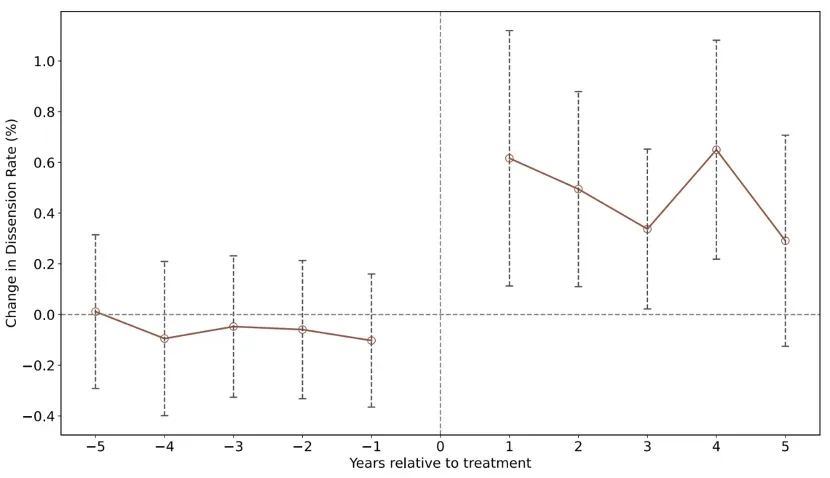
Notes: This figure illustrates the effect of a penalty observation on independent directors’ voting behavior over time. The horizontal axis measures years relative to the time in which the penalty event occurred. The vertical axis measures the change in dissension rate relative to the pretreatment period average. The dashed lines represent 95% confidence intervals for each estimated coefficient. Standard errors are clustered at the firm level.
The response is strongest when the penalty provides a more consequential or personally relevant signal. More severe penalties generate larger increases in dissent. Directors also react more when they share a professional background or gender with the penalized colleague. Sharing at least one measured characteristic increases the post-penalty effect by a further 0.395 percentage points. These patterns support the paper’s central argument that directors place greater weight on enforcement outcomes that appear more relevant to their own circumstances.
Conditions at the observing director’s current firm also matter. The increase in dissent is larger at smaller firms and firms with lower profitability, less analyst coverage, or more volatile cash flows—characteristics associated with a higher probability of regulatory penalties. A peer’s experience therefore has a stronger effect when the observing director already serves in a riskier environment.
Penalties carry substantial consequences for the directors who receive them. Following a penalty, their total salary is estimated to decline by 58%, while the number of independent directorships they hold falls by 52%. Such losses make the personal costs of insufficient oversight visible to others within the same professional network.
The authors also consider whether directors dissent merely to create a protective record. The evidence does not support indiscriminate defensive voting: even after exposure to a peer’s penalty, the predicted dissent rate remains below 1%. More importantly, firms with at least one connected director subsequently experience an estimated 0.8-percentage-point reduction in the probability of receiving a regulatory penalty, compared with a baseline of 1.82%. The decline in subsequent penalties suggests that the additional dissent accompanies more effective monitoring.
Implications
The study shows how one enforcement action can influence governance across a wider network of firms. When a director is penalized, former colleagues update their perceptions of enforcement risk and change how they oversee management elsewhere.
For regulators, the visibility of enforcement can extend the influence of existing penalties. Publicizing enforcement outcomes and making their consequences salient within director networks may strengthen monitoring incentives without changing the underlying legal rules. This channel complements credible enforcement: its influence depends on directors observing penalties that carry meaningful financial, reputational, and career costs.
For firms and shareholders, the findings reveal another function of board networks. These connections transmit more than information and professional opportunities; they also transmit warnings about accountability. Exposure to a peer’s penalty can encourage directors to challenge management more actively and may reduce their firms’ subsequent regulatory risk.

