
HKU Jockey Club Enterprise Sustainability Global Research Institute
World-Class Hub for Sustainability
Teevrat Garg | Ryan Hanna | Jeffrey Myers | Sebastian Tebbe | David G. Victor
Electric Vehicle Charging at the Workplace: Experimental Evidence on Incentives and Environmental Nudges
Sep 2 2026
Key Takeaways
- Research Question: How do flat-rate discounts and environmental information influence workplace electric vehicle charging, and how does competition for limited charging infrastructure alter their effectiveness?
- Data: The study follows 629 drivers at the University of California San Diego. Records from 323 Level-2 ports are linked to surveys on vehicles, commuting, and access to charging elsewhere.
- Method: Randomized field experiments vary environmental messages, flat charging discounts, and drivers' beliefs about how widely the discounts are offered. The authors examine charging quantity, timing, persistence, and perceived scarcity.
- Findings: Environmental messages modestly shift charging toward later, more solar-aligned morning hours without raising total demand. A larger discount increases workplace charging by 24%, but expected competition for ports pushes some sessions into the early morning and overnight. The response weakens when the discount falls.
- Implications: When incentives operate through scarce, shared infrastructure, they also reshape competition among users. Their success must therefore be assessed through system-wide effects on demand, congestion, persistence, emissions, fiscal cost, and distribution—not uptake alone.
Source Publication:
Garg, T., Hanna, R., Myers, J., Tebbe, S., & Victor, D. G. (2026). Electric vehicle charging at the workplace: Experimental evidence on incentives and environmental nudges. Journal of Environmental Economics and Management, 139, 103383.
Background
As electric vehicles become more common, the policy challenge is shifting from encouraging adoption to building a charging system that is accessible, reliable, and compatible with the power grid. Workplace charging could play an important role. Vehicles remain parked at work for long periods, often when solar generation is abundant, and shared workplace chargers can serve drivers without access to private home charging.
Yet workplace charging is a capacity-constrained shared service. Charging ports are limited, reliability varies, and using a charger also occupies a parking space. Employers may be reluctant to require workers to move their vehicles during the day, making time-varying prices and turnover requirements difficult to implement. Drivers’ choices therefore depend on the price of charging and whether they expect a port to be available.
The paper examines how these constraints shape the performance of two common interventions: flat price discounts and environmental information. Discounts may attract charging to the workplace, but they can also intensify competition and prompt drivers to secure chargers at less desirable times. Information may change behavior without increasing demand for limited infrastructure. By comparing these approaches, the study shows how incentives, information, and infrastructure jointly determine charging demand, timing, emissions, policy costs, and the distribution of benefits.
Data & Methodology
The authors conducted a natural field experiment with 629 members of the Triton Chargers club at the University of California San Diego. The analysis covers 323 of the campus's 331 Level-2 ports and records session timing, duration, and electricity use.
The main experiment proceeded in three phases, as shown in Fig. 1. Half of the drivers first received three weekly messages about the environmental benefits of daytime charging. All drivers then received either a small or large discount, reducing the usual $0.30 per kWh rate to $0.14 or $0.07. In the final phase, some drivers kept the large discount while others were moved to the small discount, allowing the authors to test short-run persistence.
Fig. 1. Experimental design.
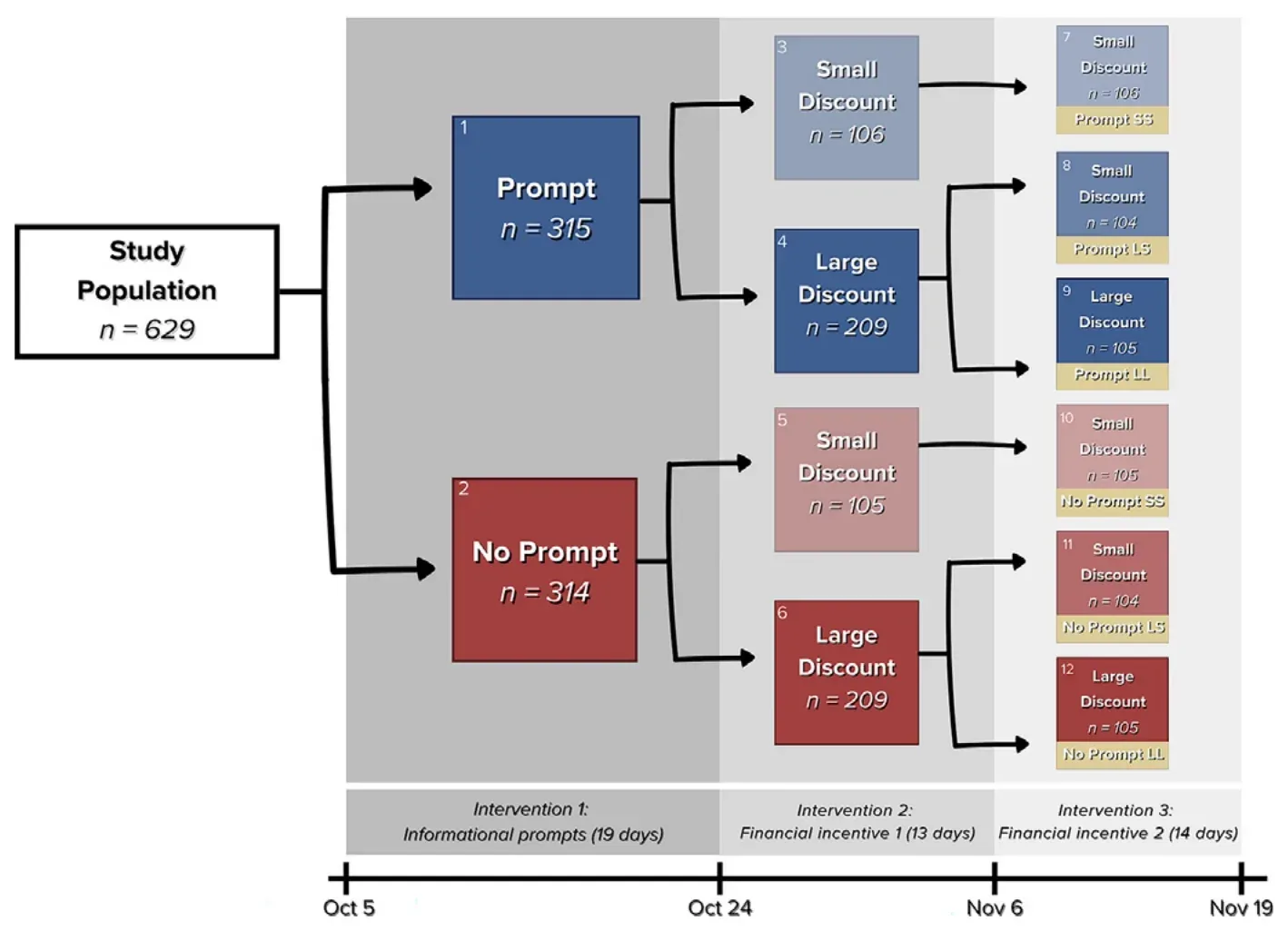
Notes: This figure shows participant assignment to experimental arms over the three phases of our experiment: informational (Oct 5-23), first financial (Oct 24-Nov 5), and second financial (Nov 6-19). Fig. A2 documents the full experimental schedule. Source: Garg et al. (2026), Fig. 1.
Three months later, a separate experiment held each driver's discount level fixed but varied whether the message implied that the discount was widely or narrowly available. This design tests whether beliefs about competition for chargers affect session timing. The authors also combine the experimental estimates with hourly grid carbon intensity to assess emissions, fiscal costs, and Low Carbon Fuel Standard revenues.
Findings
Information and prices affect different margins. Environmental messages do not change total workplace charging, but they reduce early-morning plug-ins and increase plug-ins from 7:00-9:59 a.m. About 5.9% of weekly sessions shift away from 5:00-6:59 a.m., moving charging closer to periods of rising solar generation.
The larger discount increases weekly workplace electricity use by 3.6 kWh per driver, or 24%, and active charging time by 41 minutes relative to the small discount. The implied workplace price elasticity is -0.48, showing that even a large price reduction produces a moderate reallocation of charging to work.
The discount also changes timing. In the first financial phase, early-morning and overnight plug-ins increase by 4.8% and 3.4% of weekly sessions. In the second phase, drivers whose discount is reduced move back toward the timing of the small-discount group, providing little evidence of short-run habit formation. Fig. 2 displays the average hourly profiles for all three interventions; the treatment effects are estimated from the randomized comparisons.
Fig. 2. Number of charging sessions and energy consumed by hour of the day.
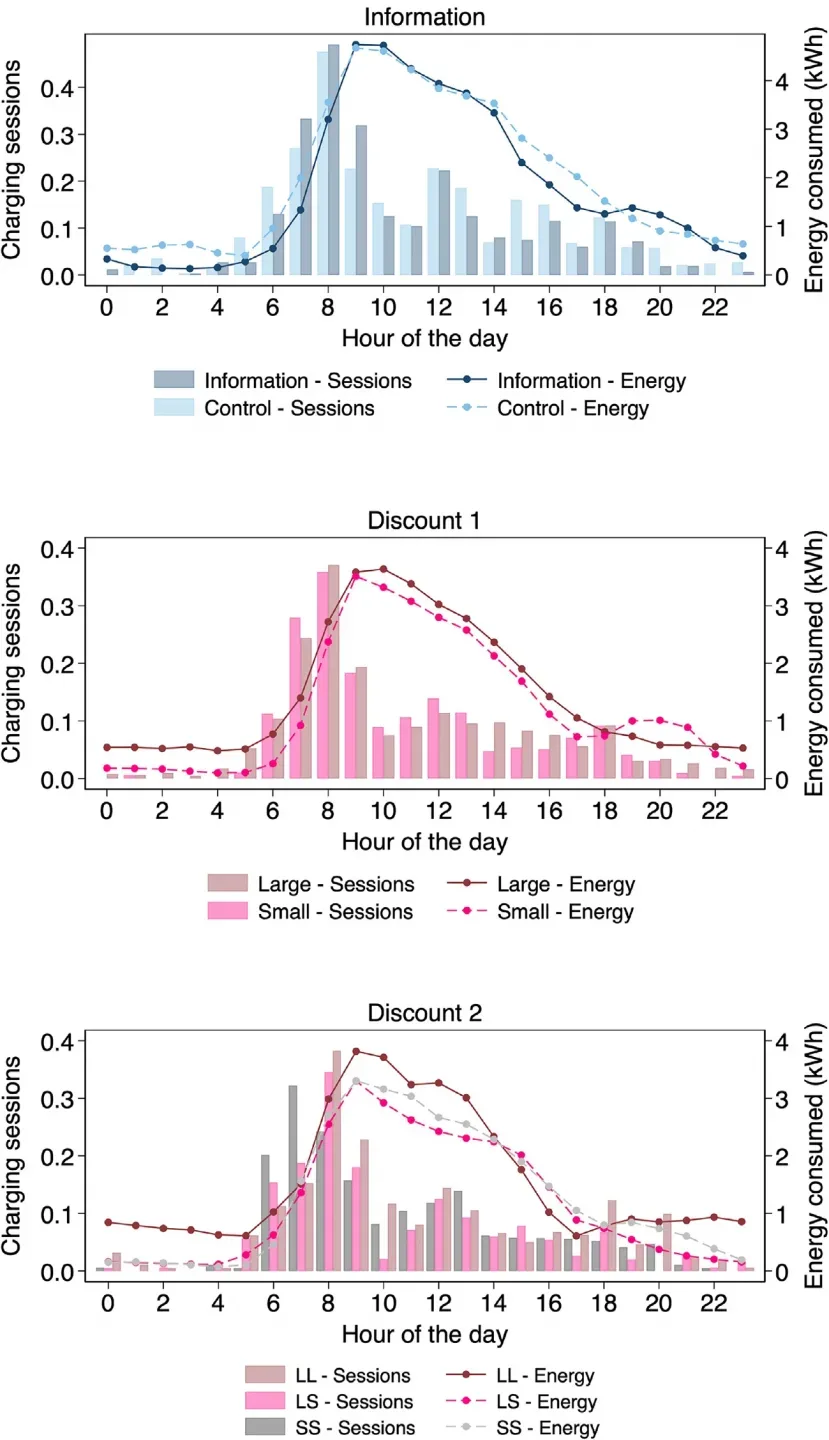
Notes: The figure displays the average number of charging sessions and energy consumed per driver, by hour of the day, over the course of each intervention – the informational (Panel A), first financial (Panel B), and second financial treatment (Panel C). Bars indicate charging sessions; lines denote energy consumed. The energy consumed assumes uniform power to the EV during active charging. Source: Garg et al. (2026), Fig. 2.
The separate scarcity experiment identifies the mechanism behind the off-hour response. Drivers led to expect that more club members would receive a discount shift sessions from the congested early morning toward late evening even though their own price is unchanged. The result points to anticipated competition for a charger rather than a change in drivers' preferred charging hours.
Fig. 3 documents the network constraint underlying those beliefs. Utilization rises rapidly after 6:00 a.m. and reaches roughly 70%-80% during the day in East and West Campus, although the pattern varies across zones. These utilization profiles are descriptive; the follow-up randomization provides the causal evidence on perceived scarcity.
Fig. 3. Charging network utilization by time of day and campus zone.
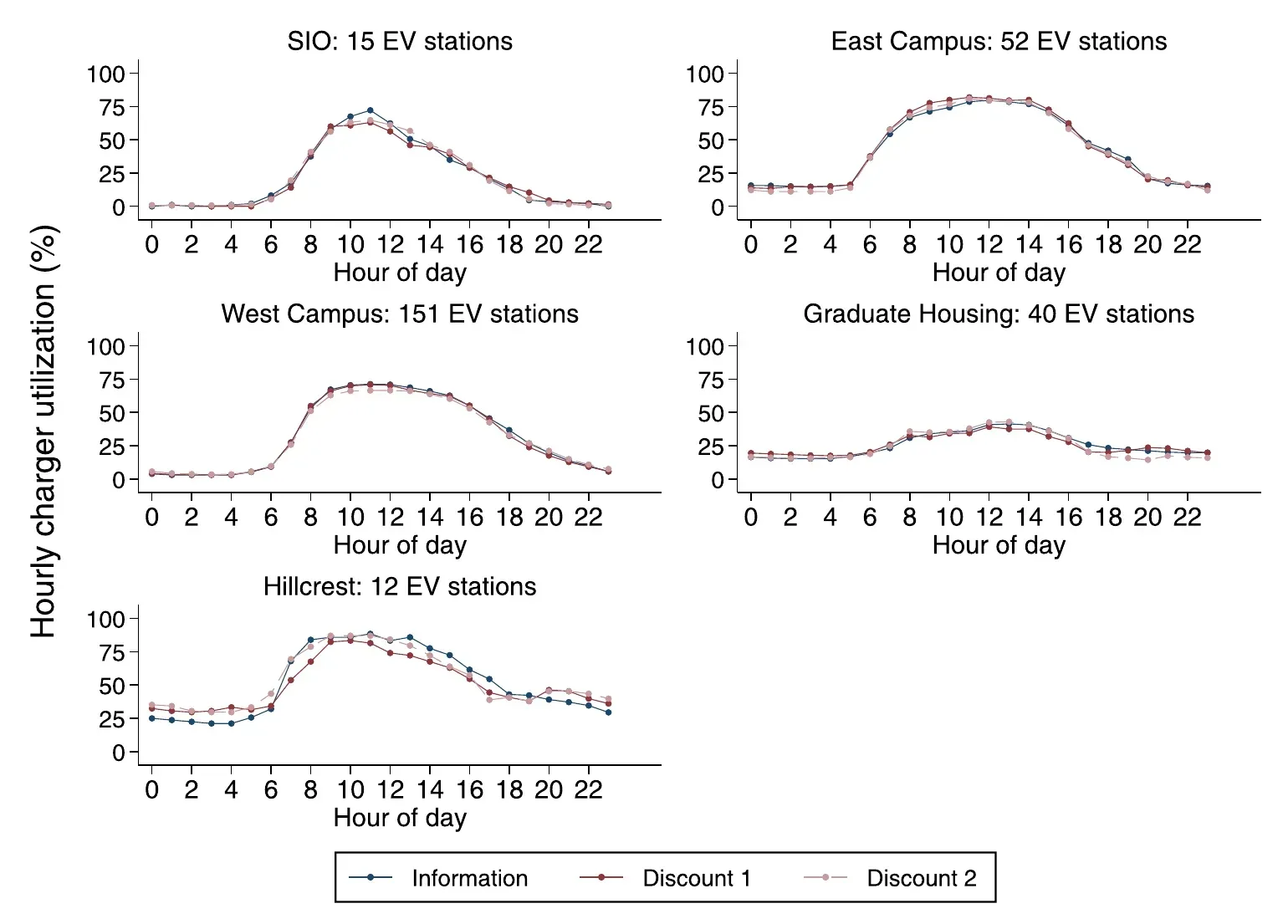
Notes: This figure shows the effective hourly utilization of chargers for the five campus zones over the experiment period (October 5-November 19). Results are the average, by hour, of all weekdays in the experiment period. We define the effective hourly charger utilization as the percentage of chargers used in a given hour relative to all chargers used during the experiment period. We exclude chargers that are non-operational and out-of-service. Fig. B1 shows the five distinct parking zones on the UCSD campus. The Hillcrest campus is around 12 miles away from the main campus. In 2023, 85% of club members never charged at the Hillcrest location; of those who did, 80% also charged at the main campus. Source: Garg et al. (2026), Fig. 3.
Network conditions also determine who can respond. The information treatment shifts timing mainly among drivers using low-utilization garages, whereas the financial treatments produce more evening and overnight charging among users of medium- and high-utilization garages. Reliability imposes a further constraint: only 86% of charging attempts deliver meaningful energy, and most timing responses come from drivers using more reliable garages. Frequent commuters and drivers without convenient charging alternatives are also more responsive.
The emissions calculation combines two opposing margins. Moving charging from home to work can displace charging at more carbon-intensive hours, while early-morning and overnight workplace sessions move emissions in the other direction. Estimated emissions fall by 1.18% under information and 1.49% in the first financial phase, but rise by 1.58% in the second. The paper treats these small estimates as evidence that the climate effect of a workplace incentive depends jointly on charging location and timing.
Financial discounts also redistribute Low Carbon Fuel Standard revenues from the local utility to the workplace host, with estimated workplace revenue gains of 22.2% and 7.9% across the two phases. These are order-of-magnitude calculations. Discount use per driver is similar across income groups, but higher-income households receive most benefits in aggregate because they are overrepresented among current electric vehicle owners. The short experiment at one university is most informative for similar professional workplaces.
Implications
The study shows that increasing workplace charging is not the same as making charging cleaner. Discounts increase use, while environmental messages mainly change timing. Policies must therefore match the intended outcome: charging location, quantity, or timing.
Scarce infrastructure can also alter the effect of an incentive. Discounts increase expected competition for chargers, prompting drivers to secure them at less desirable hours. Charger availability, reliability, access rules, and automated load management are therefore part of incentive design—not merely operational details.
Finally, subsidies should be judged by their full costs and incidence. Their effects may fade when payments end, their emissions benefits may be small relative to their fiscal cost, and their benefits may accrue disproportionately to higher-income users. More broadly, incentives delivered through shared, capacity-constrained systems should be evaluated by how they change congestion and competition, not only individual demand.