
HKU Jockey Club Enterprise Sustainability Global Research Institute
World-Class Hub for Sustainability
Liya Chu | Kent Wang | Bohui Zhang | Guofu Zhou
ESG and the Stock Market: Is ESG Exposure Systematic?
Aug 26 2026
Key Takeaways
- Research Question: Does aggregate ESG (environmental, social, and governance) improvement in the overall economy contain information for the stock market as a whole?
- Data: The study uses monthly data from 2009 to 2019, covering environmental, social, and governance indicators. Additional analyses use alternative ESG data extending through 2023.
- Method: The authors aggregate firm-level indicators and use partial least squares to construct market-level ESG indices tailored to forecasting aggregate returns. They explore predictive performance using both conventional regressions and alternative machine-learning approaches.
- Findings: A higher level of the composite ESG index predicts an increase in the following month’s market excess return. The index also predicts aggregate future fundamentals and is associated with lower market uncertainty. Both expected cash flows and discount rates contribute to return predictability, with the discount-rate channel playing a larger role.
- Implications: The findings on the significant market-wide impact of the ESG provides support for the economy-wide importance of the ESG risk and for the central role played by governments.
Source Publication:
Chu, L., Wang, K., Zhang, B., & Zhou, G. (2026). “ESG and the Stock Market: Is ESG Exposure Systematic?” Management Science. Published online June 24, 2026.
Background
Over decades, valuation of companies has shifted from solely financial metrics to include Environmental, Social, and Governance (ESG) concept. While existing studies find that corporate sustainable measures are important for predicting the cross section of stock returns, there are conflicting findings, with some studies showing a positive relationship between high ESG metrics and expected returns and others showing the opposite. The firm-level evidence does not show whether ESG matters for the market as a whole. If aggregate ESG improvement has market-wide impact, ESG is not merely a characteristic at individual firm level; it has systematic relevance for the broader market.
Moreover, the understanding of ESG based on only one specific indicator is actually incomplete as the basic conceptual scope of ESG is indeed about the broadest range of stakeholders connecting the entire society. The authors therefore examine whether a market-level composite ESG index capturing sustainable growth information from the environmental, social, and governance categories predicts future stock-market returns and explore the economic driving forces behind the predictability of ESG.
Data and Methodology
The study uses monthly Sustainalytics data from August 2009 to September 2019, covering 38 firm-level indicators: 14 environmental, 11 social, and 13 governance measures. These indicators capture corporate practices ranging from carbon intensity and renewable-energy use to workforce diversity, social supply-chain standards, whistleblower programs, tax transparency, oversight of ESG issues, and sustainability-linked executive compensation.
The authors aggregate each indicator across firms and use dimension reduction methods such as partial least squares to combine them into a market-level composite ESG index. The index is intended to capture aggregate corporate ESG performance which evolves gradually with firms’ policies and economic conditions. It primarily reflects policy implementation and the underlying capacity of firms to engage in ESG activities.
Figure 1. Time Series of Market-Level Composite ESG Index
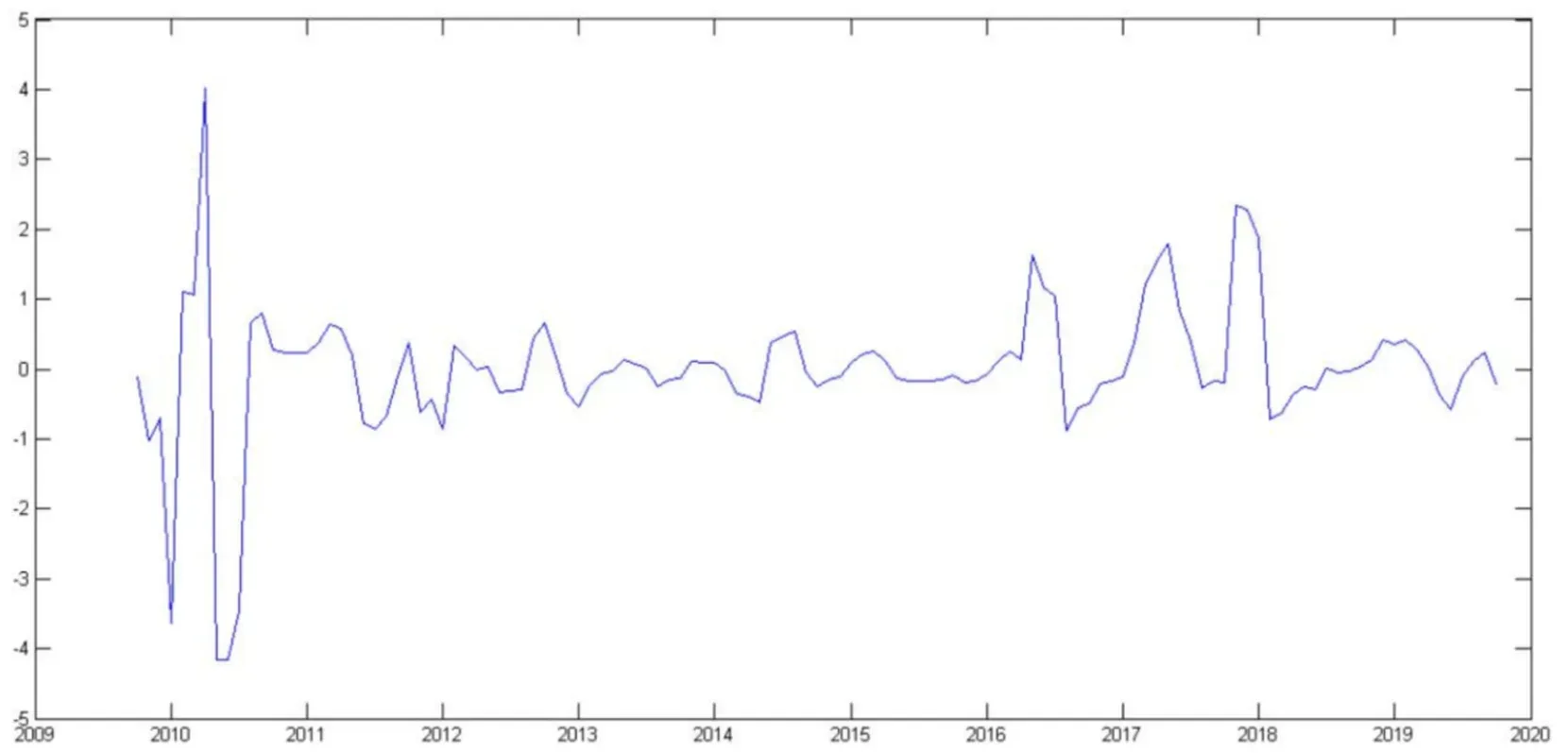
Notes: This figure plots the time series of the market-level composite ESG index. The index covers all three ESG categories and is standardized. The sample spans the period from August 2009 to September 2019.
The main analysis tests whether the index predicts the following month’s value-weighted U.S. market return in excess of the Treasury-bill rate. The authors also examine horizons of up to three years, and control for conventional market return predictors and measures of macro uncertainty and fundamental growth.
Additionally, the authors supplement the baseline analysis with two cutting-edge machine-learning approaches. The first predicts stock returns firm by firm and then aggregates them into the market portfolio, taking advantage of large cross-sectional data. The second method applies a model complexity approach to show the economic value of market timing with ESG information. These machine learning techniques help further verify predictability of ESG beyond traditional prediction framework with limited out-of-sample size.
Findings
Systematic role of ESG in asset pricing
The composite ESG index positively predicts subsequent returns at the aggregate market level. This finding indicates that the core value of ESG can be consistent with enhancing firms’ value as well as achieving broader societal goals – a win-win result for both shareholders and stakeholders.
The composite index capturing sustainable growth information from the environmental, social, and governance categories exhibits stronger forecasting performance than the sub-indices capturing information from only one of the three categories, implying collective benefits aggregated through a more comprehensive base of stakeholders.
The result persists after accounting for conventional market predictors, fundamental growth variables, and measures of uncertainty, and remains evident over longer return horizons. Analyses using monthly change in aggregate ESG incidents and reputation, and alternative rating measures provide further forecasting evidence in samples extending through 2023.
Out-of-sample performance based on pooled firm-level data offer additional support. When neural-network forecasts for individual firms are aggregated into an S&P 500 forecast, the predictive model consistently achieves positive out-of-sample relative to the historical-average return. More flexible models also generate gains in market-timing exercises.
Underreaction to predictability of ESG on future cash flows
The ESG index positively predicts future aggregate firm fundamentals, however, due to several particular reasons, investors’ ESG-related demand tends to underreact to this information about future cash flows, so that the value of ESG is not fully priced in the market, leading to higher market return going forward. This evidence challenges the assumption of market efficiency and ESG-motivated investors in the literature. Subsample analysis further reveals that ESG predictability is state-dependent: when aggregate ESG concern is low, market-wide ESG information is underweighted and predictability emerges; when the concern is high, markets process ESG information more efficiently.
Resolution of market uncertainty
A higher ESG index forecasts subsequent declines in market risk. This evidence suggests that market-wide ESG improvements contain information about the future resolution of market uncertainty. In addition, investors may be slow to incorporate ESG-related risk reductions. As information about market-wide ESG conditions gradually diffuses and becomes incorporated into prices, periods of lower risk are followed by higher subsequent returns at the aggregate market level.
A decomposition of market returns identifies both cash flow and discount rate channels as the two economic drivers of market return predictability, and the latter is the more economically important source.
Why time-series evidence differs from cross-sectional patterns
Time-series predictability requires aggregation across firms. This aggregation cancels out the ESG-adjusted component of equilibrium expected returns documented in recent research. Consequently, the negative price pressure effect from ESG investors’ demand, which lowers expected returns in cross-sectional settings, is largely eliminated at aggregate market level.
Overall, in time-series analysis, the price pressure effect is offset through aggregation, while the other two effects (market-wide underreaction and resolution of market uncertainty) remain, which correspond to the cash flow and discount rate channels, respectively. The findings do not contradict previous ESG studies but complement them by emphasizing the importance of employing a time-series framework to examine the market-wide impact of ESG.
Implications
This study underscores the crucial role of ESG information in the broader stock market and the macroeconomy. Importantly, the systematic role of ESG highlights a shift in practice from establishing ESG disclosure rules at individual firm level towards actively monitoring and regulating the wider impact of ESG information on the stability and functioning of financial markets as a whole. Because of its market-wide importance, this study helps to attract the attention of market participants, scholars as well as policy-makers and regulators to the fast-growing ESG research.